






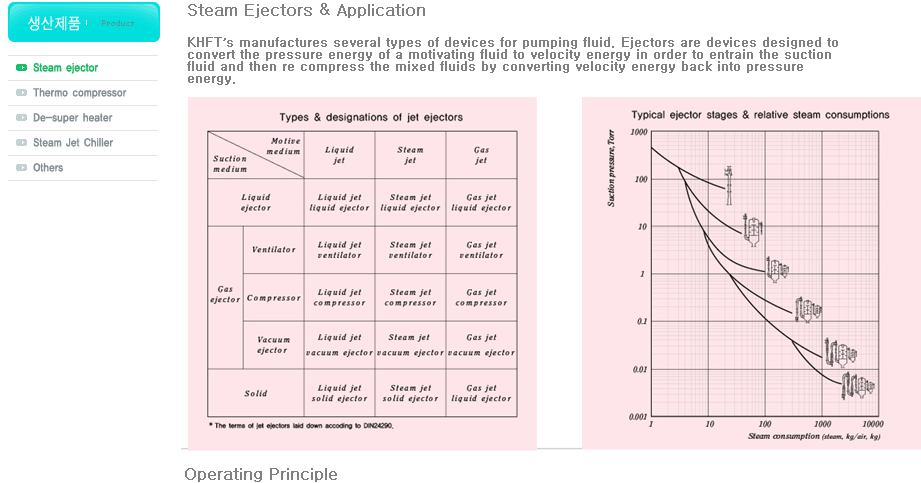


Steam jet ejector is a device for producing vacuum which is achieved by using a high pressure motive steam. The primary advantages of steam jet ejector are simplicity of operation, no mechanical drive and has no moving parts.
The high pressure steam is supplied in steam chest (1), and expanded through jet nozzle (Converging & diverging nozzle causes the velocity up to mach number 3.0 or 4.0) and them motive stream injected into a suction chamber.
The suction chamber has the lowest static pressure (approximately equivalent to the suction pressure Ps). The suction fluid enters into the suction chamber(3) and is mixed with motive steam in the diffuser inlet (4). Kinetic energy of motive steam is transferred to the suction fluid through diffuser throat (5).
Motive steam & suction fluid mixtures are converted the velocity energy to the pressure energy (recompressed to the discharge pressure Pd) through diffuser outlet (6).
Korea Heat & Fluid Tchnology research has produced numerous improvements in steam jet ejector design and test results.
Figure 2 illustrates suction capacity which calculated by computer at entrance of diffuser. Suction capacity at right figure is 133kg/hr which corresponds to minimum value to the curve. Sometimes there is no minimum value, in this case, eddy current occurs and suction capacity decreases suddenly (By professor Ueda).
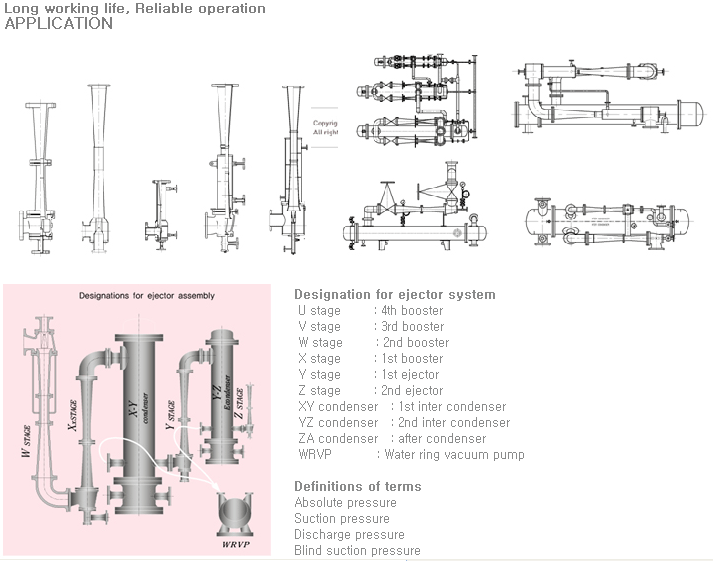

This equipment is also available from a wide variety of non-metals such as Teflon and Graphite.
These are easy handling even of unusually large suction quantities, low operating costs, and long working life.suddenly
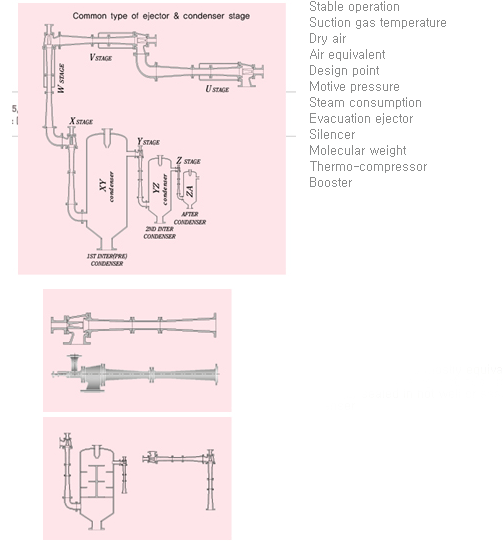
Single stage steam ejector
A single stage steam ejector is used for ultimate suction pressure 10kPa (75Torr) and normal suction pressure up to 15kPa (120Torr).
Discharge pressure is mostly equivalent to the atmospheric pressure, for exhausting the following methods are employed. (1) up to silencer and muffler, (2) sealed in hot well or seal pot with pressurized vent, (3) after condenser.
Two stage steam ejector
Two stage steam ejectors are used for suction pressure 20kPa (150Torr) or below, and the ultimate suction pressure is up to 2kPa (15Torr).
Two stage steam ejectors include three types ; (1) two stage non-condensing ejector : small capacity, (2) two stage ejector with barometric inter condenser : continuous operation and steam consumption per capacity is lowest, (3) two stage ejector with surface inter condenser : eliminates water contamination and product recovery system.
Three stage steam ejector
Three stage steam ejectors are used for suction pressure 5kPa (38Torr) or below, and the ultimate suction pressure is up to 0.5kPa (3.8Torr).
Three stage steam ejectors are include three types ; (1) three stage non-condensing ejector : small capacity and intermittent service, (2) two stage booster and 3rd ejector with inter condenser : continuous and high vacuum range, (3) three stage ejector with two inter condenser : achieve maximum steam economy. Impossible to condense gas at pressure too low to permit condensation (suction pressure below 25Torr), with available cooling water. This case consist of vary large 1st stage (booster), which is always designed to compress the vapors to the condensable pressure.
Four stage steam ejector
Four stage steam ejector is designed for high vacuum range, suction pressure 0.5kPa (3.8Torr) or below, and ultimate suction pressure in up to 0.07kPa (0.5Torr). The suction pressure is below 4.6Torr, steam saturation temperature is sufficiently below 0℃ to freeze moisture in the suction gas and motive steam, thus the forming of ice between jet nozzle and diffuser inlet. The avoid of the ice formation, required steam jacket the jet nozzle and diffuser.
5th stage steam ejector
Five stage and six stage steam ejector are commonly used for special process and space research field, and vacuum metallurgy process such as RH-OB degassing unit at POSCO.
 | |||||||||||||||||||||||||||||
 |
| ||||||||||||||||||||||||||||